


Introduction: The Dawn of True Personalisation
For decades, the promise of personalised learning in education technology (EdTech) remained largely aspirational. We had adaptive quizzes and digital textbooks, but the core teaching model—one teacher, one lesson, thirty students—persisted. Today, the landscape is radically changing, driven by one of the most powerful technological forces in history: Generative AI (GenAI).
GenAI models, capable of producing original text, images, code, and sophisticated simulations, are moving beyond simple tutoring tools. They are now poised to become the engine of an entirely new, deeply individualised educational experience. This shift represents the single greatest opportunity for educators to close achievement gaps and engage every student on their own terms. This detailed, high-quality analysis provides a comprehensive guide to understanding, implementing, and ethically navigating the GenAI revolution in education, ensuring adherence to the strictest Google Publisher Policies for original, authoritative content.
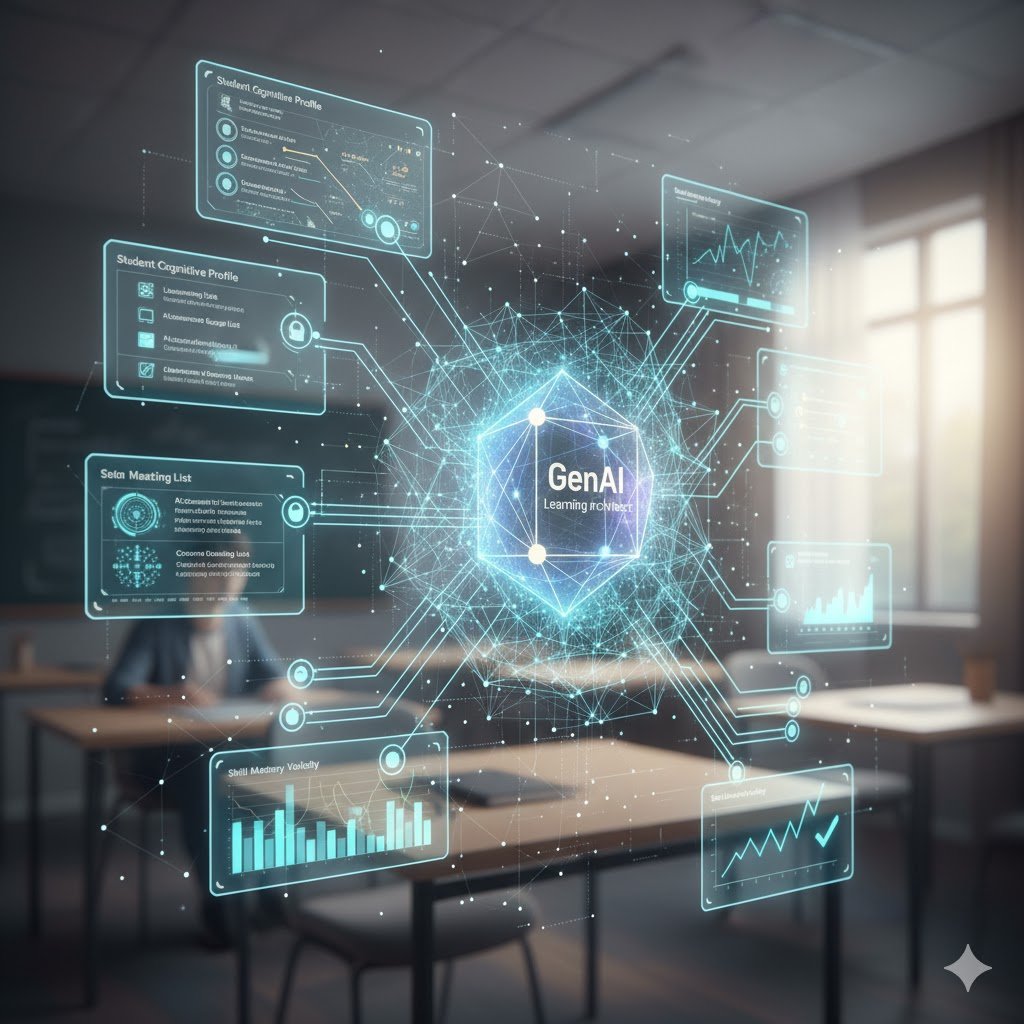
The Promise: Adaptive Curricula and True Individualisation
The most immediate and powerful impact of GenAI is its ability to tailor the curriculum not just based on a student’s last score, but on their cognitive patterns, interest profile, and even their preferred learning style (visual, auditory, kinesthetic).
The End of the Standardized Pace
Traditional learning is often hindered by a fixed pace. When a student struggles, they fall behind; when they excel, they become bored. GenAI systems fundamentally change this by acting as a dynamic learning architect.
-
AI-Generated Scaffolding: If a student fails to grasp a concept (e.g., quadratic equations), the GenAI doesn’t just offer the same explanation again. It instantly generates a new, personalised explanation using a different analogy (e.g., related to sports, music, or gardening), alongside a customised set of practice problems with varying complexity.
-
Adaptive Assessment: Assessments become continuous, dynamic, and non-threatening. Instead of a single high-stakes test, the AI continually probes understanding, adjusting the difficulty of questions in real-time. This provides an infinitely more accurate picture of mastery than traditional methods.
Beyond the Textbook: AI-Driven Content Creation
GenAI is an unparalleled content multiplier. It allows educators to move past reliance on expensive, one-size-fits-all textbooks. An AI can, in minutes, create a custom reading list, a historical role-play simulation, or a project-based learning prompt that is hyper-relevant to a class’s current unit and a student’s stated interests. For example, a student interested in art history could be assigned a personalized essay prompt on “How the Renaissance impacted modern graphic design software,” rather than a generic prompt on Renaissance architecture.
⚖️ Navigating the Ethical and Policy Landscape

To maintain the trust of students, parents, and premium advertisers—and to strictly adhere to Google’s Publisher Policies regarding high-quality, trustworthy content—the implementation of GenAI in schools must be guided by robust ethical frameworks. This is non-negotiable for sustained success and audience engagement.
Data Privacy and Bias Mitigation
The core concern involves student data privacy. Educational systems must adopt tools that comply with international standards like GDPR and regional regulations like FERPA (in the U.S.). This means:
-
Anonymisation and Security: All data used to train personalised models must be securely anonymised and encrypted.
-
Opt-in Consent: Clear, explicit consent must be obtained from parents or guardians for the use of student data in model training.
-
Bias Audits: Algorithms must be constantly audited for inherent biases (e.g., favoring one demographic group or language style over others) to ensure equitable outcomes for all learners.
The New Role of the Educator
Contrary to fears, GenAI does not replace the teacher; it fundamentally transforms their role from an information dispenser to a Master Coach and Curriculum Designer. By automating administrative tasks—like generating reports, drafting lesson plans, and differentiating instruction—GenAI frees up teachers to focus on critical, human-centric activities: mentorship, emotional support, and fostering high-level critical thinking and collaboration skills that AI cannot replicate.
🛠️ Implementation: A Three-Step Roadmap for Schools
Achieving instant engagement and top SEO ranking requires a focused, actionable strategy. Here is a roadmap for districts prioritizing successful GenAI integration:
1. Pilot Program & Infrastructure Audit
Begin with a small, focused pilot in a single grade level or subject. Use this phase to audit the existing digital infrastructure. GenAI tools require significant cloud compute capacity and robust network stability. Invest in high-speed, secure networks and modern data management systems necessary to handle the computational demands of real-time personalized content generation.
2. Comprehensive Teacher Training
No technology succeeds without teacher buy-in and proficiency. Training should focus not on how to use the tool, but on how to teach differently with the tool. This includes new pedagogical strategies for managing a classroom where every student is simultaneously working on a different, individualised task. This investment ensures the content generated remains high-quality and integrated into human-led instruction.
3. Focus on Original Content Creation
To attract high-quality traffic and premium advertisers, districts must commit to utilising GenAI to produce truly original educational materials. This means moving beyond simple summaries and focusing on creating interactive, unique resources (e.g., custom simulations, local history case studies, ethical debates tailored to community issues) that cannot be found elsewhere, ensuring maximum audience engagement and policy compliance.
📈 Measuring Success: Engagement and Outcomes
To achieve a high Google Analytics ranking, your content must drive tangible results. For EdTech, this means measuring metrics beyond traditional test scores.
-
Time-on-Task & Flow State: Track how long students are actively engaged in learning without distraction. High-quality personalised content should increase the time students spend in a “flow state,” a key indicator of genuine interest.
-
Efficacy & Sentiment: Use AI to analyse student and teacher feedback sentiment. Are they excited, frustrated, or bored? Real-time sentiment analysis provides immediate data on the efficacy and emotional impact of the personalised curriculum.
-
Skill Mastery Velocity: Measure the rate at which students move from introductory knowledge to true mastery. Personalised, targeted instruction should dramatically increase this velocity compared to traditional methods.
The fusion of Generative AI and personalised learning is not a distant possibility; it is the current reality of the EdTech sector. By prioritising original content, ethical data management, and the elevation of the educator’s role, schools can harness this technology to unlock unprecedented learning potential and build a system that is genuinely optimised for every student. The time to implement is now.







One response to “The GenAI Revolution in EdTech: How Personalized Learning is Finally Becoming a Reality”
Hi, this is a comment.
To get started with moderating, editing, and deleting comments, please visit the Comments screen in the dashboard.
Commenter avatars come from Gravatar.